Wednesday, October 31, 2012

Ohio Early Voting Continues to Favor Obama Heavily

With Ohio becoming such a pivotal state in the now very tight race for President, numerous organizations are conducting polling of Buckeye state voters.  Ohio has early voting, and Ohio voters have been casting ballots now for several weeks. 

Many of the polls in Ohio report data on the preferences of those early voters.  We also have a pretty extensive archive of polls with similar data from the 2008 race.  So what can we conclude, so far?

First off, the early claim by Romney's campaign that they were running neck and neck with Obama in early voting clearly does not hold up to scrutiny.  We now have data from more than a dozen polls (all listed in reverse chronological order below) in Ohio, every one of which shows Obama with a significant lead over Romney among early voters, ranging from a high of 76%-24% to a low of 52%-46%.

Moreover, the margin of Obama's lead has not changed significantly as the number of early voters has increased over time.  For example, Survey USA has conducted four polls in Ohio during October.  In the first, Obama was ahead among early voters by 59%-39%; in the second it was 57%-38%; in the third it was 58%-39%, and in the most recent it was 56%-40%.

The most recent polls suggest that between a quarter and a third of Ohio likely voters have already gone to the polls, so Romney will have his work cut out for him come election day to make up that deficit.  In seeing how likely that is, it is instructive to look at the 2008 data.  When averaging the polls, it does appear that Obama's 2012 advantage among early voters is about 4 points lower than in 2008.  Since Obama won by 4% in 2008, this could be a very close race.  However, it appears that a greater percentage of voters are voting early this time around, so Romney has a smaller base to use on election day to climb back in it.

Finally, we can do a little head-to-head comparisons between 2008 and 2012 with polls taken by the same organizations.

Survey USA conducted polls in 2008 and 2012 that were concluded eight days before the election. In 2008, 22% of it's sample had already voted, favoring Obama by 56%-39% over McCain.  In 2012, 25% of the sample had already voted, favoring Obama by 56%-40% over Romney--basically no difference.

Likewise, Public Policy Polling conducted polls in 2008 and 2012 that were concluded about a week before the election.  In 2008, 30% of it's sample had voted, going for Obama by 65%-34% over McCain.  In 2012, 33% had already voted, favoring Obama by a margin of 62%-35% over Romney.

We wish we had some data from 2008 from Rasmussen to compare to it's 2012 polls. However, even in 2012 alone, Rasmussen appears inconsistent.  On Oct. 25, it reported that 35% of it's sample had already voted, giving Obama the edge by 52%-46% over Romney--the smallest margin in any Ohio poll so far.  But three days later, Rasmussen reported another Ohio poll.  This time, 32% had already voted, but Obama's margin was 62%-36%--a big swing from three days earlier.  So, which Rasmussen poll to believe?

Obviously, both campaigns are in high gear in Ohio right now.  But time is running out, as many Buckeye voters have already cast their lot.  It's pretty clear that Romney's campaign will have to get it's voters out on election day to catch up.  That's still quite possible, but for now Obama retains an edge.


OHIO EARLY VOTING


Note:  As of today, we have 17 polls from Ohio with early voting data. We compared the average of those polls to the average of all similar polls from Ohio in 2008. While Obama, on average, has a big lead in the early voting in Ohio this time around (average of 59%-37%), his lead in 2008 was even bigger, at 60.5%-34% over McCain. 


Oct. 26-29: Survey USA--25% already voted
Obama 56%
Romney 40%


Oct. 29-30: Public Policy Polling--33% already voted
Obama 62%
Romney 35%
Oct. 29-30--CBS/Quinnipiac--doesn't say what % of survey already voted
Obama 60%
Romney 34%

Oct. 28: Rasmussen--32% already voted
Obama 62%
Romney 36%
Note: Not sure how to square this result with the Rasmussen poll just three days earlier!!

Oct. 25: Rasmussen--35% already voted
Obama 52%
Romney 46%

Oct. 23-25--ARG--28% already voted
Obama 55%
Romney 44%

Oct. 23-25: Purple Strategies--26% already voted
Obama 58%
Romney 32%

Oct. 25: CNN--59% EXPECT to vote early, no breakdown beyond that.
Obama 59%
Romney 39%


Oct. 23: Rasmussen--31% already voted
Obama 53%
Romney 43%


Oct. 22-23: Time--20% already voted
Obama 60%

Romney 30%


Oct. 20-22: Survey USA--26% already voted
Obama 58%
Romney 39%


Oct. 21: Suffolk Univ.--20% already voted
Obama 54%
Romney 41%

Oct. 21: CBS News--20% already voted
Obama 54%
Romney 39%


Oct. 18-20: Public Policy Polling--21% already voted
Obama 66%
Romney 34%

Oct. 16: Survey USA--18% already voted
Obama 57%
Romney 38%

Oct. 12-13. Public Policy Polling--19% already voted.
Obama 76%
Romney 24%

Oct. 5-8. Survey USA--11% of sample had already voted.
Obama 59%
Romney 39%

Monday, October 29, 2012

Storm surge potential for Hurricane Sandy likely to flood NYC subway system

In Landstrike, my fictional version of a major hurricane striking New York City, one of the more devastating effects of the storm was flooding of the NYC subway system due to storm surge up the Hudson River.

Fictional hurricane Nicole in Landstrike was predicated on a worst case scenario for New York--a strong hurricane striking just south of the city, thereby forcing the greatest storm surge up the Hudson River.

It now appears that Hurricane Sandy may bring that disastrous scenario to real life.  Here's what meteoroligist Jeff Masters had to say earlier today about the storm surge potential:

"This evening, as the core of Sandy moves ashore, the storm will carry with it a gigantic bulge of water that will raise waters levels to the highest storm tides ever seen in over a century of record keeping, along much of the coastline of New Jersey and New York. The peak danger will be between 7 pm - 10 pm, when storm surge rides in on top of the high tide. The full moon is today, which means astronomical high tide will be about 5% higher than the average high tide for the month, adding another 2 - 3" to water levels. This morning's 9:30 am EDT H*Wind analysis from NOAA's Hurricane Research Division put the destructive potential of Sandy's winds at a modest 2.9 on a scale of 0 to 6. However, the destructive potential of the storm surge was record high: 5.8 on a scale of 0 to 6. This is a higher destructive potential than any hurricane observed since 1969, including Category 5 storms like Katrina, Rita, Wilma, Camille, and Andrew. The previous highest destructive potential for storm surge was 5.6 on a scale of 0 to 6, set during Hurricane Isabel of 2003. Sandy's storm surge will be capable of overtopping the flood walls in Manhattan, which are only five feet above mean sea level. On August 28, 2011, Tropical Storm Irene brought a storm surge of 4.13' and a storm tide of 9.5' above MLLW to Battery Park on the south side of Manhattan. The waters poured over the flood walls into Lower Manhattan, but came 8 - 12" shy of being able to flood the New York City subway system. According to the latest storm surge forecast for NYC from NHC, Sandy's storm surge is expected to be 10 - 12' above MLLW. Since a storm tide of 10.5' is needed to flood the subway system, it appears likely that portions of the NYC subway system will flood. The record highest storm tide at The Battery was 10.5', set on September 15, 1960, during Hurricane Donna."

We suspect that subway flooding is only part of the story, as there are many low lying areas of NYC and its surrounding communities along the Hudson River.  We don't think it will be quite the magnitude of Landstrike, which was a more powerful and concentrated storm than Sandy, but we do think the coming disaster will cost billions and have long-lingering effects.

Wednesday, October 17, 2012

Ohio Early Voting Favors Obama

Note:  For more up to date info on Ohio (with over a dozen polls) and other states, see our more comprehensive post, updated daily, Poll Results for Early Voters.

If you're wondering why Republicans have been so keen to shut down early voting in Ohio, just look at the data.  So far we've found two polls that include early voting in their data.  In both, Obama has a commanding lead among those who have already voted:

Survey USA did a poll on Oct. 5-8.  In its sample, 11% of respondents said they'd already voted.  Of those, 59% voted for Obama, 39% for Romney.

Public Policy Polling, which tends to lean Democratic, conducted a survey on Oct. 12-13.  In its sample, 19% said they'd already voted.  Of those, 76% were for Obama, 24% for Romney.

And most recently, Survey USA conducted a poll on Oct. 16, in which 18% of the sample had already voted, with a 57-38 split in favor of Obama.

This is no surprise.  At about this point in the 2008 election, Survey USA reported that 12% had voted, and that they had gone 57% for Obama and 40% for McCain.  Ultimately, Obama comfortably carried Ohio in 2008, wining 51%-47%.

In the 2008 election cycle, we collected data from more than 80 polls that included information on early voting, and posted it HERE

We will look at this year's polls from here on out and begin posting anything interesting.  Early voting is already on quite a pace in Ohio, North Carolina, Iowa and Maine according to early voting expert Michael McDonald, a professor at George Mason University, (see here), so the results should be interesting.

There Ought To Be MORE Undecided Voters

To hear the election pundits, it's a surprise that there are still voters out there who, so close to the presidential election, remain undecided.  As in, what more will these voters learn in the next few days and why haven't they already made up their minds?

The real surprise, however, is that there aren't MORE undecided voters.  After all, both candidates are pretty disappointing, and neither has a particularly realistic vision of what can be done in the next four years.

Perhaps if we had more undecided voters, the quality of discourse in debates and campaign appearances would be greater.

To be sure, the Curmudgeon will be voting for Obama.  Not because we think he's done a great job in his four years in office, but because he is decidedly better than the alternative.  We probably would have been okay with the moderate Mitt Romney who served as governor of Massachusetts, but that Mitt disappeared in the bowels of the Republican primaries and is not likely to return, beholden as he is to the GOP right.  In any event, Mitt's prescription for restoring the economy is a true disaster--it really is more of what got us into the problem to begin with.  Obama is no Bill Clinton, but at least he'll stalemate a largely Republican Congress.

Let's take last night's debate as an example of why there should be more undecided voters.  Face it, neither candidate answered the questions.  Obama was asked what he would do about $4 a gallan gas, and proceeded to brag about increased domestic production of oil and gas, which is a result of the prior administration's policies.  But that has not reduced gas prices--and it won't. 

Our guess is that voters don't want to hear that government policies have little to do with the price of gas.  They also have short memories.  Gas was at $4 a gallon near the end of the Bush administration.  Then it plummeted to less than $2 a gallon at the beginning of the Obama administration because the economy tanked--not because of any policy of Obama or Bush.  It is now BACK to $4 a gallon because DEMAND has recovered (in line with the economic recovery that Romney says hasn't occurred).

Romney didn't have anything better to say.  He would increase domestic production, but there's not much more increase to be had, and in any event oil is a fungible global commodity, the price of which depends on global demand.

Another question went to Romney, concerning his tax plan.  Romney says he will lower tax rates, but offset that with elimination of deductions and credits.  That is certainly feasible, but Romney truly has never said which deductions and credits he would eliminate.  The questioner asked quite specifically about certain deductions--mortgage, charitable, childcare, education.  Of course, Romney completely dodged the question. 

Romney threw out there that perhaps one way to do it would be to allow a total deduction of a limited amount that could be spread among whatever deductions apply to you.  Huh??  When has he EVER said that was part of his plan before?  And if it is, let's have the DETAILS.  Our bet is that some taxpayers would be winners in that, and some losers, but you'd have no way of knowing under his "plan"--more like a vague sketch.

In any event, the fundamental premise of Romney's tax sketch is fatally flawed.  He says that by lowering rates, we will create jobs because small businesses will have more money to do so.  WHAT?  That is not economics.  Business owners don't create jobs because they have more money--that's absurd.  They create more jobs because demand for their products and services have increased to the point that they MUST add jobs.  No business owner wants to add employees just for the sake of it.  If anything, they want to eliminate employees and operate more efficiently.  The goal of business is to make money, not create jobs.

Now, if you want to create jobs with government policy, the best way to do so is to stimulate demand for goods and services.  With tax policy, that can be done by reducing taxes for the the largest number of taxpayers, putting more spending money in their pockets.  That was in large part the theory of the stimulus.  But since--as Romney has pointed out--47% of Americans pay no income taxes, reducing income taxes won't help about half the people to demand anything else.  Further, since income tax payments are concentrated in the wealthiest Americans, reducing income taxes puts money disproportionately into the pockets of the wealthy, who already have more than enough discretionary income to buy whatever they want.  In other words, it does not lead to economic stimulus.

In short, Romney's tax sketch is not likely to create many jobs.  On the other hand, Obama doesn't have room, given the current deficit situation, to do much either.  And neither candidate spoke about the real elephant in the room:  the fiscal cliff.

We could go on and on--both candidates dodged gun control, Romney lied about his positions on health care and Obama evaded on Libya.  The fact of the matter is that the President can only do so much in our deliberately divided government, with all its "checks and balances."  Congress is gridlocked, and will remain so.  The President can be a cheerleader, but that's about it, other than on foreign policy.  That, more than anything else, probably explains why this election seems more likely to be decided on style and emotional issues (such as contraception coverage) than substance.

As for you remaining undecided voters--good for you, you may be the only sane people in our electorate!

Monday, July 02, 2012

Inside The Virginia Derecho

By now, many of you have heard the term "derecho" used to describe the intense meteorological event that wreaked havoc across much of Virginia and the metro DC area Late Friday night.

A derecho is a long-lived, fast moving line of intense thunderstorms with straight line winds in excess of 60 mph. The line is often bowed. It is a warm weather phenomenon--the storms get their intensity and propulsion when the colder air associated with the storms clashes with warmer air in front of the line.

Friday's derecho started near Chicago in the early afternoon and raced southeastward at about 60 mph, fueled by an intense mass of steamy hot air that set records throughout the mid-Atlantic that day.

To its credit, the intrepid weather bloggers at the Washington Post's Capital Weather Gang issued an alert late Friday afternoon (about 4:00 pm) that there was a 50 percent chance of "storms capable of producing damaging winds and/or hail" coming through between 10 pm and 2 am, after already pummeling parts of the midwest. I doubt if too many people took notice, as they were mostly just trying to survive the hottest June day ever recorded in DC.

As the night progressed, the wife and I were watching Wimbledon highlights on television, while I surfed the weather radar. The derecho was clearly headed our way, and looked powerful on the weather maps. The wife was a bit dubious about my explanation of a derecho and what this might cause.

Right around 11:00, with Roger Federer coming back in his Wimbledon match, the lights began to flicker and dim. The derecho was clearly evident just a few minutes away on radar. We stepped outside and it was deadly still, muggy and hot. But we could see some pretty intense lightning flashes to the west.

Just minutes later, out of nowhere, an intense wind gust caused our front door to pop open. Then all hell broke loose in an instant. It was if we had been in the calm of the eye of a hurricane one moment, then experienced the back side of the hurricane coming through the next. The wind was howling, loose items were careening down the street, trees were swaying and tree branches snapping. Torrential rain (we got .60 of an inch in 20 minutes) was blowing in sheets sideways, punctuated by bits of hail. The lightning was strobing in non-stop white flashes with blinding blue flashes every few seconds as transformer after transformer blew.

Right at the outset, the power went out, then flickered back on. Then it went for good--everything around us, including the brightly lit commercial district a block from our home, was dark, but for the brilliant white and blue flashes illuminating them. Unfortunately, our automatic, natural gas fed generator failed to kick in.

The storm was at least as intense as anything we saw during the height of Hurricane Isabel a few years ago, but it only lasted about 20 minutes, if that. We watched the intense trail of lightning tail off to the east as an eerie dark quiet settled over Arlington. After the remnant rain settled to a sprinkle, I checked on the generator--no luck, it was definitely kaput, the victim of maintenance neglect.

At least it had cooled off, so we had a fine night of sleep.

The next morning, reality set in. More than 60% of Arlington was without power. Our Verizon FIOS service was out. Cell phone coverage was spotty, wi-fi down. We couldn't get any cash--ATM's either lacked power or were temporarily disabled due to network problems. We found an open diner for an early breakfast, but they couldn't process credit cards. By the time we left the diner (after charging a couple phones) there was a huge line out front.

We decided to get a hotel room nearby. We were just in time, as a line was forming there too. Since their systems were down, it was cash only also. Fortunately, we had the cash!

So now it's Monday, a full three days later. Our power has partially returned at home, but only some circuits are working. Apparently we're on a dual circuit with the power company, only one of which is working. Unfortunately, that does not include any air conditioning, nor our washer, dryer, dishwasher, or basement freezer. And our internet and cable are still out as well, but we do have our hotel room!

We're luckier than many. Huge swaths of Arlington still lack power. I went to our local Target store today to get some items and it was operating on a generator, leaving the back parts of the store eerily dark. Many traffic lights are still out, and gasoline is scarce (glad the Prius had a nearly full tank-- should last awhile). Our house, especially the upper two floors, is sweltering. We figure it will be the end of the week before things get back to "normal".

Sit could have been worse. If the storm had hit late afternoon, it would have caught a lot of people outside, or trapped on roads in their vehicles. Thousands of spectators at the AT&T Open in Bethesda would have been at risk. In that respect, we were lucky, although the storm still managed to take more than a dozen lives.

So that's it, for now, inside the derecho zone.

Monday, June 25, 2012

What I Learned From 50 Shades of Grey

Ok, so after seeing that practically every woman in the U.S. was reading Fifty Shades of Grey and its offspring over the past few months, I decided to see what all the fuss was about.

It was very instructive.  I learned that:
  • Women are as shallow as men
  • Women's literary standards are no higher than men's
  • Women, apparently, will totally degrade themselves sexually and emotionally IF a man is utterly handsome, extraordinarily rich and uses expensive body wash
I also learned that IF--and apparently only IF--a man is utterly handsome, extraordinarily rich and uses expensive body wash, then a woman will:

1.  Have an orgasm during intercourse with him EVERY TIME, right before he climaxes.

2.  Doesn't need any meaningful foreplay.

3.  Doesn't require or desire any kind of oral foreplay.

4.  Will have sex with him at any time of the day or night.

5.  Will have sex with him during her period.

6.  Doesn't mind being controlled and dominated, or spanked and flogged.

Also, said man will automatically be well endowed.  And, he can "do it" at any time of day or night, up to at least six times in one day.  (Wait'll you get older, buddy!)

Furthermore, said man's brother and sister will also be hot; the woman's friend will be hot.  In fact, everyone will be hot.

Finally, the other guy who is the same age as the woman, who cares for her, does nice things for her, and apparently is at least also attractive, will lose out every time.

I won't be reading the rest of the trilogy, thank goodness, as my writing skills would surely deteriorate.  Back to spy thrillers and weather disasters for me!

Thursday, February 02, 2012

CRITICAL: Tracing The Deficit--It's Bush's Fault

For anyone remotely interested in national politics, the Washington Post buried an incredibly important economic analysis deep inside its "A" section yesterday.

Entitled, "Doing The Math On Obama's Deficits," the article, by Ezra Klein, analyzes the federal government's recent budget deficits to determine what proportion came from policies of George W. Bush, and what from Obama.  [There's also a follow-up today, here.]

What we find is that since W Bush became President in 2001, his policies have added $5.1 trillion to the national debt, while Obama's policies have added $983 billion.  And that's generous, because the analysis tagged Obama for $620 billion for the two-year extension of the Bush tax cuts.

All told, the Bush tax cuts have added about $2.5 trillion to the national debt since being enacted.

Let's not forget that when Bush took office, he inherited a budget surplus of more than $200 million per year.

So when the Republicans label Obama as fiscally reckless, let's look at the facts.  Can our nation afford another period of Republican rule?  Borrow and spend is not good policy.

Friday, January 13, 2012

Bondi Compounds Her Tax Problem

Melissa Bondi is now facing scrutiny from the "mainstream" press about her tax problem, or should we say problems.  Her response is not encouraging.

The worst thing a candidate for public office can do when faced with a question about their personal behavior is to lie about it.  Yet, that appears to be the path Bondi has chosen, and it will undoubtedly exacerbate the problems for her campaign.

Here's the two tax problems Bondi has:
1. A nearly $20,000 IRS lien for failure to pay taxes on income earned a few years ago; and
2. The apparent failure to pay personal property taxes on a car she garaged in Arlington for a couple of years.

As an aside, commenters on various blogs and news sites have raised other questions, but they seem beside the point.  She was late on some car tax payments a few years ago--ok, but she paid them, and a lot of people are late at some point in paying bills.  Another candidate, Kim Klingler, had the same problem, but really it shouldn't be disqualifying.  Also, some commenters have complained that Bondi is now not an Arlington taxpayer at all, suggesting that should disqualify her for office.  We don't see that as very pertinent--an Arlington resident who rents her abode and has no car can still be an excellent County Board member. 

However, not paying taxes, and then evading the truth about it, is serious. 

As for the IRS lien, Bondi's story is that until the tax judgment appeared on the Arlington Yupette blog a few days ago, she didn't know about it.  That is pretty hard to believe.  The IRS is far from perfect, but they don't file a tax lien without first making mulitple efforts to notify you of the tax delinquency and offering you an opportunity to negotiate the delinquency, all the while threatening the dire consequences that will befall you if you fail to act.  Also, when you get hit with a tax lien--which is public--all kinds of lawyers and other types come out of the woodwork offering to "help" you with the IRS.  Since the lien judgment has Bondi's correct address, it's hard to see how she somehow missed all that correspondence--some of which, by law, is required to be sent by certified mail.

Most telling is that in today's Washington Post article on the issue, Bondi "would not say" whether she received notices or warning letters. So, in other words, maybe she didn't know about the lien (still hard to believe), but she certainly knew about the delinquency.  It would be one thing if she was in correspondence with the IRS disputing the delinquency and the IRS upped the ante by filing a lien--they will do that; but that doesn't appear to be her story.

The car tax issue is also problemmatic.  Apparently, sometime in 2006 Bondi gave up her own car, but used a car that belonged to her father, who lives out of state.  The fact that a car is registered out of state, however, does not exempt it from personal property tax.  If the car is garaged in Arlington, it is subject to the tax. Bondi hasn't yet said anything to clear up this issue.  While the amount of money is probably quite small, we do think it says something about someone who wants to serve on Arlington's Board.  Paired with the other tax issue, it says volumes.

Now, people make mistakes, and if we only elected perfect people to public office, we wouldn't have any public officers.  We're more troubled at this point, however, with how Bondi is handling her mistakes. 

With four other committed Democrats running for the Board nomination, we think Arlington Democrats have better choices.

[The Curmudgeon is supporting Terron Sims.  But we'd change horses in a nanosecond if he had Bondi's type of problems.]

Tuesday, January 10, 2012

Bondi's Tax Problem

According to a posting on Arlington Yupette, County Board candidate Melissa Bondi has a tax problem with the IRS, which resulted in a judgment of nearly $20,000 against her back in March. (And public records confirm the judgment:  http://landrec.arlingtonva.us/public/ViewDoc.aspx?popView=false&hideForm=&docId=1621576&fileId=1479128&id=53&cat=j&origin=retrieval )

We'd like to know more about this inasmuch as Bondi has been reported as a frontrunner in the five-way race for the Democratic nomination to replace Barbara Favola on the Board.  The Democratic nominee will most likely win the seat; in turn, the Democratic nominee will be selected by a tiny percentage of the electorate at a "firehouse primary" type of caucus, probably by a plurality vote.  Since there is very little turnover on the County Board, it's important to know more here.

So far, the news outlets that cover Arlington politics--the Sun Gazette, Arlnow.com, to some extent the Washington Post--have been mum.  Some suggestions in comments on the Yupette page suggest it had to do with unreported income from some form of self employment.  It's pretty significant, however, that whatever the source, the IRS had to litigate and go to judgment--and we wonder if the judgment has been paid.

Our concern is about getting someone on the Board whose ethics are suspect.  Arlington has long been blessed by good government, without significant scandals, unlike some of our neighbors, such as D.C. and P.G. County.  Paying your taxes is a civic responsibility, and electing representatives who fail in this basic obligation is a clear path to trouble.

We'll be looking for more on this one in the days to come--much better that it come out before the caucuses, rather than after, lest Democrats find a way to blow the special election in March.

Friday, December 02, 2011

Soccer Ridiculousness--Part 2

In Soccer Ridculousness Part 1 we went over the absurd comments of college soccer coaches who object to any limits on current year-round training and competition for collegiate players.

Today, we cover the current push to prohibit elite players in the high school age group from competing with their schools.

In recent years, the powers that be in US youth soccer established an "academy" program for boys to supplement, compete with and generally confuse things with the existing Olympic Development Program, which was already confusing because it really has nothing to do with the Olympics.

Adding to the confusion, the girls have a different elite training program.

Putting aside, for the moment, the counterproductive effects of having multiple, overlapping and somewhat conflicting "elite" programs, let's get to what the boys Academy program is now trying to do.

Unlike ODP programs, which are run by state associations, the Academy program is run by individual soccer clubs who apply for the Academy franchise.  To get the Academy designation, they must meet certain standards and abide by certain rules that are supposed to enhance player development.

One of the rules now being proposed in the Academy is to PROHIBIT Academy players (all of whom are in high school age groups) from playing for their school teams.  This is a hugely misguided idea.

It is true that the quality of coaching at many high schools is inferior to that provided at the club level (not just the Academy clubs--almost any club).  High school seasons also conflict with club seasons; high school training conflicts with club training.  Many club teams "sit-out" the high school season to avoid conflict.

The Academy purists, however, believe that the high school season is detracting from the superior training of their young proteges, so they would simply get rid of the schools.

But that creates a huge dilemma for player who want the benefits of the Academy.  School soccer is VERY important to these kids.  In club games, the spectators are parents.  Many of those parents have been pushing their kids since kindergarten, yelling at them and countercoaching them from the sidelines.  Parents, being parents, are solely concerned about their kids, not the team.

In school, the spectators are fellow students.  They are cheering for the team--and its stars.  Being a star on the high school soccer team is a big deal for the ego of a student.  It gives the player an exalted place in the hierarchy of the school social strata.

Now, take the same kid, who everyone knows is a great soccer player, and have him (or her) suddenly NOT playing for the school team because his/her club team is so much more important.  Now that player not only loses the exposure to his/her school's cheering students, but actually becomes a traitor to the cause.  "Hey John, you're the best player at the school, how come you're not playing for the team?"

Potomac Soccer Wire recently had an excellent piece capturing just how agonizing this choice can be for players.  In this particular case, involving a girls team, the adults helped them work it out the right way--but that's getting increasingly rare.

The Academy and the various adults who rule youth soccer should not be creating this dilemma for players.  There is a better way to go:  improve high school coaching.  There is no reason that most schools cannot use club coaches for their school teams and adopt club training methods.  Some high schools already do this, and others should.  It won't be the Academy, but the Academy can easily work around the high school schedule and still give its precious charges the training and competition they need.

We'll add one more thing.  The folks behind the Academy think that they are bringing a European concept to US youth soccer.  In Europe, the professional soccer clubs run academy programs to identify and develop new talent.  But the US model is different in critical ways, and DOOMED TO FAILURE as a poor imitation of the European model. 

In Europe, the pro club academies don't charge for their programs.  As a result, they are drawing from the pool of ALL European players, and they are an attractive option for poor kids to pull themselves up.  The US academies, mostly at elite suburban clubs, do charge for their programs, and they attract a talented group of players from a limited subset of the population.  It's the exclusion of the rest of the population that makes all the difference!


Tuesday, November 29, 2011

The Future Car Is Literally Just Around The Corner

We've previously stated that it's only a matter of time before we humans stop the activity known as driving a car.  Cars will drive themselves--doing a better job than most humans--while humans use their time in their metal exoskeletons for other purposes.

Well, Volkswagen has announced that it will make it's "follow me" technology available on certain delivery vans in Europe shortly.  This technology allows a vehicle to literally follow its driver as he/she walks down the street, or to come pick up the driver from about a block away.

This is the next logical step from automated cruise control and cars that can park themselves.  Of course, it's only a few more steps to fully automated vehicles.  We can think of some immediate good uses for such, even as many drivers cringe at the thought.  One is for blind people--what a blessing an automated car would be for them!  Likewise for others with handicaps (permanent or temporary) that prevent them from driving.

Another group is very old people who can no longer safely drive.  Just think, Florida could be the capital of automated driving.  (Come to think of it, no one in Florida drives very well.)

There's also folks who have lost their driving privileges, either temporarily or permanently.  They're a good market for the new technology because they usually have lost their right to drive due to BAD DRIVING.

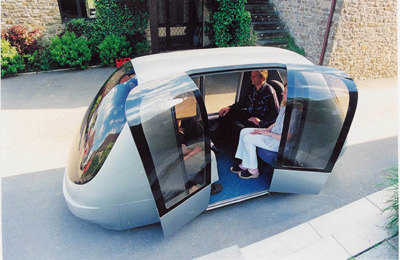
Looking further down the road, so to speak, we foresee a whole new car concept.  A driverless car can be configured completely differently from today's cars.  There is no need for a steering wheel, brake pedal, accelerator and dashboard in such a car--those are for humans.  Likewise, there is no need for fixed seats that face forward.  Instead, you can have seats that swivel so a group can have a discussion while riding.  Or, seats like those in first class on international flights that can lie flat so you can go to sleep.  Leave for grandma's at midnight, take an Ambien and wake up a few hours later at your destination.

Indeed, there's no need for windows on such a car, although most people will want them.  But the windows could also be darkened, or better yet, turned into computer screens.  You could surf the web and play video games; of course, there will be those who watch porn as well.  Which leads to other things you could do while riding in an automated car with someone you love.

If all cars were automated, you could also make them a lot lighter and smaller.  Little women wouldn't insist on SUV's so they can see over traffic, and we wouldn't have to engineer massive cars of sheet metal to survive collisions with idiotic drivers of other massive piles of sheet metal.

And if all the cars are automated, they can go a lot faster, getting you to your destination more quickly.  That's because automated cars would not need, for example, the staggered start that humans take at a stop light--they could all start at the same time and pace.  You might not even need stoplights--just a system by which the vehicles yield to each other, as they could know exactly where all the cars around them are going.

You can also drink and ride--at least up to a point.

The way people interact with cars would be quite different as well.  No need to look all over for a parking spot--you'd get dropped off where you want to go, and then the car would go find it's own remote parking spot.  When you're ready to go, you just ask the latest version of the Siri app on your smart phone to have you picked up.  Like an instant cab without the smelly driver.

Furthermore, if you can summon a car to pick you up, anytime, why own a car?  Why not sign up for a car sharing service and get whatever type of vehicle you need at the time.  Driving into the office?  Order up a nifty electric one-seater.  Taking the family to the beach?  Get something more akin to an SUV, but without having to OWN one and drive it on the daily commute.

There will still be problems to work out--that smelly person who had the car before you; the people who leave their trash behind; the people who try to override whatever safety systems are in place, etc.  You can always count on a few people to do their best to ruin a good thing, but most of these obstacles will be overcome.

It'll be a good while before everything's automated--there will always be a few diehards crying out about "freedom" to drive themselves (at least until they try one of those porn trips).  But, the day is coming.  Just look down the street.

Soccer Ridiculousness--Part 1

In a belated effort to restore some semblance of balance to collegiate athletics, the NCAA is considering some significant changes to off-season training for a number of sports, including soccer.  Currently, collegiate athletes in soccer pretty much face year-round training and competition, including international tours in the off-season.

The NCAA's Resource Allocation Workgroup is proposing to ban off-season competition and international tours, and to reduce the number of games in the season by about 10 percent.  These are rational steps to reign in a sport--that like many others on college campuses--has gotten out of control.

Yet to hear the college soccer coaches yowl, you'd think the NCAA was proposing to shut soccer down.  These coaches--many of them foreigners--need to realize that college soccer is NOT PRO SOCCER, even though it may appear that way at times.

An article in last week's Potomac Soccer Wire illustrates the hysteria.  “The spring [off-season] games are critical,” noted University of Utah women’s soccer coach Rich Manning on his twitter feed. “Who would want to run, lift and train for 6 months a year with no games. And when you consider the NCAA doesn't allow players to play on outside teams, it's almost a death sentence to anyone getting better from ages 18-22."

A death sentence?  Coach, most of these players are going to have to go on to something other than soccer, or at least they should (although coaching apparently is always an option).  They ought to have some time to do something else in their lives.  They don't need to train all year either.  Yes, they need to maintain their conditioning, but that's not the same.

As for getting better (or playing all the time), if they want to go pro, go pro. 

Anyway, other sports also have only one season.  Football, basketball, baseball, to name a few.  Although it is true that some of these teams--notably basketball--do tour around the world in the off-season (remember Georgetown's brawl with a semi-pro team in China this past summer?), so we hope the rules will be enforced equitably.

Bad as the Utah coach's comments are, they pale in comparison to the utterly ridiculous statements of Rob Kehoe, Collegiate Programs Director at the National Soccer Coaches Association of America.  He's quoted in Potomac Soccer Wire thusly:  “If you have players that have eight months without competition opportunities, what happens to their discipline? In a campus situation, they’re going to be bored and involved with the scourge of the college campus, which is substance abuse and relationship abuse issues. The sport serves as a deterrent from being involved in things that are irresponsible, illegal activities that are very prevalent on college campuses."

Whoa!  We had no idea that colleges were such cesspools, with soccer literally being the only thing saving these poor young men and women from a life of destitution and ruin.

Soccer is a good sport, but it's only a sport.  There are plenty of good ways of allowing college soccer athletes to maintain (and even improve) their skills without subjecting them to year-round competition.  They need an occasional break from soccer, and time to focus on what the rest of their lives will bring.

Soccer COACHES, of course, have nothing better to do, but that's exactly why they shouldn't be the ones determining what limits should be placed on the sport within colleges.

Tuesday, November 22, 2011

VA GOP Takes First Step Toward Self Destruction

We knew they couldn't resist.

With its new dominance of all of Virginia's government, what's the first bill pre-filed by a GOP legislator?  Why, of course, a bill to define human life as starting at conception.

Even Mississipians rejected this really bad idea.

The question is whether Virginia's Republican legislators, needing to play to their base, will have the good sense to say "no" to this bill.  If not, they'll put Governor McDonnell in an awkward position, one that will dash any aspirations he has for higher office (Senate, GOP VP nominee)--if he vetoes such a bill, he loses the religious right; if he signs it, his moderate image (the basis for his success so far) is shattered.

Moreover, if this bill goes into law (and believe us, this one is just the tip of the iceberg--you can bet there are plenty of other religiously inspired bills to come from the same group), Republicans can kiss their majority goodbye in short order.

VA voters are concerned about the economy.  They didn't elect Republicans to institute a Taliban of state-controlled religion in the Commonwealth.

Friday, November 04, 2011

First World Problems Versus Third Word Problems

This morning my older son reminded me how trivial some of our utter frustrations can be. 

It wasn't a great morning.  The Curmudgeon is a single parent for most of this week, and it's the first hour and a half of each school day morning that is the real challenge.  The last two days were great, though, with everything running like clockwork.

Yesterday, however, unbeknownst to me, our housekeeper apparently unplugged my clock radio, then plugged it in and reset the time, but she conveniently had me "fall back" an hour just a little too soon for the switch to standard time this weekend.  As a result, my alarm would have gone off an hour late this morning, but for one of the kid's alarms waking me up only a half hour late (and quite confused as to why his alarm was going off at what seemed like 5:35 a.m.).

So this morning was a big rush, with dad grumbling quite a bit about our housekeeper's negligence.

Then older son lightens the mood on our trip to school by saying this a good example of "first world" problems and how they compare to third world problems.

First world problem:  alarm clock reset to wrong time;
Third world problem:  no electricity

First world problem:  this steak is medium, not medium rare
Third world problem:  we have no food

First world problem:  she said something mean about me on Facebook
Third world problem:  a militia group raped all the girls in our village

You get the picture.  So next time you're angry about something that has happened to you, play the first world/third world game.  You'll feel better.

Tuesday, November 01, 2011

Why VA Independents Should Vote Dem In State Senate Races

If you're one of Virginia's many independent voters, next Tuesday's elections--especially for state Senate races--should be of great interest to you. 

Virginia has a large group of mostly moderate independent voters.  They tend to be fiscally conservative and socially libertarian, i.e., they don't want the government telling them what to do in their bedrooms or with their guns.  Their primary interest is in getting good government services as efficiently as possible.  Not surprisingly, these sensible folks are disgusted with both major parties.

For those of you who fall into this large category of independent voters, Tuesday's election is important because if the Virginia state senate swings to a Republican majority, the Commonwealth will be--for the first time in many years--a single party state, with the GOP controlling both houses of the legislature as well as all the major constitutional offices (governor, lt. gov., AG, etc.)

That will, in turn, unleash social conservatives to push--and enact--a flurry of regulations on conduct, as well as to turn on the spigots for spending on conservative programs.  No, it turns out that Republicans are not against regulation, nor are they against welfare spending--it's just a matter of who/what they want to regulate (sexual mores) and who they want to reward (businesses, churches).

As long as Democrats continue to control the state senate, neither party can go too far off the rails with its agenda.  The current stalemate is not ideal--on some issues, particularly transportation funding, the legislature has gotten nowhere for years.  Virginians increasingly pay a higher and higher price each year for the lack of investment in transportation infrastructure.  But it's not like Gov. McDonnell's solution of sticking a tollbooth every few miles and pretending its not a tax is going to solve the problem.

In any event, independent voters have an important stake in how this election goes.  Republicans bill the election as a "referendum on Pres. Obama," but Obama's got nothing to do with it.  The real issue is whether Virginia is going to retain the balance that has served it so well over recent years.

Sunday, October 30, 2011

Perfect for Halloween: Sorcerors and Apprentices

We commend to you The Sorcerers and Their Apprentices: How the Digital Magicians of the MIT Media Lab Are Creating the Innovative Technologies That Will Transform Our Lives, by Frank Moss.


Moss is the recent former director of the MIT Media Lab, and the book is an informal tour of the Lab's discovery process, which has brought us such things as digital books (where I read this one).


The MIT Media Lab is an agglomeration of scientists, engineers, artists and other experts into what Moss calls "anti-disciplinary" fields such as Kindergarten for Life, Opera of the Future and New Media Medicine. To say that the Lab is doing "cutting edge" work in science and technology would be an understatement--the folks in the lab are, in many areas, re-inventing the way things are done, from city driving to doctor's office visits.


It's a short read, less than 240 pages, and a fun one. Learning how the Lab's denizens in the City of the Future group, for example, have created a foldable car that can be stacked like luggage carts at an airport is fascinating. The technologists in the lab don't just dream up great--but perhaps impractical--ideas. They implement them by creating working prototypes and then giving the technology away to their many corporate sponsors.


While the gadgets and systems created at the Lab are mind-boggling, Moss's bigger point is the process of creation at the Lab--the antidisciplinary approach. The new "city car," for example, was created by a team that included only one automotive engineer, which gave them the freedom not only to think outside the box, but to discard the box altogether.


Some of the Lab's projects are almost magical in nature. The book highlights the roles of many of the quirky people involved in this process of creation. These are not boring people, and the book is a fun read that makes one optimistic for the futue.


The only negative is Moss's occasional myopic tendency to imply that no one else in the world is doing similar work. We doubt that's the case, but surely labs like MIT's are still pretty rare, and the approach used there could be more widely adopted in academic and corporate settings.


Who knows, maybe they'll even figure out a way to make Blogger's buttons work in Explorer 9!

Thursday, October 27, 2011

GOP--The Party of Fiscal Irresponsibility?

Here's a biting op-ed from an oldline Republican doubting the current crop of GOP presidential candidates' commitment to fiscal responsibility:

http://economix.blogs.nytimes.com/2011/10/25/the-republican-idea-of-tax-reform/?emc=eta1

We'll just add that borrow and spend is no better--probably worse--than tax and spend.

Wish we could go back to the days of fiscally conservative, but socially liberal Bill Clinton and Al Gore!

(Hat tip to LS for the article).

Monday, September 19, 2011

How To Save The Postal Service

It's hard to believe that people are upset that the Postal Service might have to cut out Saturday mail delivery.


Really, is there anything that comes in the mail on Saturday that couldn't wait until Monday?


The fact of the matter is that NOTHING particularly time sensitive comes in the mail. Yes, we do need mail service, but why not limit it to two times a week--say Tuesday and Saturday? Would it really make a difference?


The mail is a little like human food digestion. A lot of stuff goes in, a tiny amount of with actual nutritional value is extracted, and the rest gets excreted as waste.


In our household, the Curmudgeon processes the mail. More than 90% of it gets immediately dumped into the recycling bin. The rest goes into one of two piles: stuff that needs to get filed (eventually--usually on a rainy day), and stuff that needs some kind of action (mostly, bills). The action items get addressed about once a week.


Oh, and there are the magazines, but even the so-called newsweeklies are no longer all that timely--any real news we've already gotten off the net from our smartphone. Being old-fashioned, we like having magazines around, but waiting until tuesday, or Saturday, to receive them would be no big deal.


So, to those who oppose eliminating Saturday delivery, we say fine--let's keep Saturday, and get rid of most of the rest of the days!

Memo to GOP Fatcats: Don't Block My Driveway!

This evening, one of our neighbors hosted a fundraiser for Caren Merrick, the Republican candidate for state senate in our local district.

Hey, we have no problem with that. But one of the GOP fatcats attending decided it was just too much trouble to find a legal parking space, so instead parked completely across our driveway. They're fortunate that Mrs. Curmudgeon was feeling charitable and only had them ticketed--the Curmudgeon would have had them towed (and jr. Curmudgeon wanted to put an obscene sign on their windshield).

Meanwhile, a small group of protesters gathered outside the fundraiser to urge another attendee--Congressman Frank Wolfe--to support the Jobs Bill. More than our usual level of excitement on North Edgewood St.!

Maybe we'll have a fundraiser for Merrick's opponent in November, Arlington Co. Board member Barbara Favola.

Monday, August 29, 2011

Irene Was A Good Warning For the Northeast

Although Hurricane Irene turned out a little weaker than many forecasts, it still caused at least $5-10 billion in damage, while serving notice to the mid-Atlantic and northeast about what a more powerful storm could do.


Some observations post-Irene.


1. Forecasting landfall for a hurricane approaching the Atlantic coast is quite difficult. As is usually the case for storms like Irene, the forecast track steadily slipped northward over a period of days, moving from the lower South Carolina coast to the middle of North Carolina. Had Irene's track been just 50 miles further east, it could have missed NC altogether (skirting the Outer Banks) and remained a stronger hurricane as it approached further north.


2. Likewise, forecasting hurricane intensity is difficult. Fortunately for NY and New England, Irene did strike NC first, taking out quite a bit of its energy. But even before it approached NC, Irene weakened a fair amount. In constrast, in 1989, Hurricane Hugo ramped up in intensity just hours before striking Charleston, SC. Better to err on the side of overpreparation, however.


3. There was more time to prepare for Irene than would be the case for some storms. Irene approached at a relatively leisurely pace for an Atlantic hurricane coming at the east coast (less than 15 miles per hour). The 1938 "Long Island Clipper" was going 60 miles per hour when it hit NY. In the future, there could easily be storms where the lead and warning time is half that of Irene.


4. A large storm like Irene is particularly dangerous. Irene was a good sized hurricane, with tropical storm force winds extending a good 200 miles from its center. A storm that size striking the east coast is always going to cause a lot of damage because there are so many people and cities concentrated in the region. Irene sent moderate storm surges over hundreds of miles of coastline; blew down trees over a huge area; and dropped flooding rains on at least ten states.


5. A slightly more powerful version of Irene could cause catastrophic damage. If, as forecast, Irene had strengthened to a Category three storm before landfall, and if it had just missed NC before turning toward the Atlantic Coast, it could have dealt a devastating blow to NY, NJ and/or New England. As it was, as a large tropical storm Irene managed to flood parts of New York City and devastate several NJ beaches. A more powerful storm on the same track could easily have upped the damage ante to $50 billion, or even $100 billion.


6. NYC is ready to take hurricanes seriously--NYC officials treated the threat soberly, as did many--but of course not all--New Yorkers. As illustrated in the Curmudgeon's novelization of a major hurricane striking NYC (Landstrike), the consequences of a major hurricane making a direct hit on the city would be devastating. We just hope there's no backlash in attitudes because the storm ended up a little weaker than advertised.


Fortunately, geography and climate make the odds of a major hurricane striking NYC at any given time quite small. Irene illustrated that point. But, when the big one does hit--and one day it will--the consequences will be devastating.